
No Wadena 72-Hour Release Feed
The only verified Wadena County jail output is the timestamped In Custody List. Searches of the sheriff site and report namespace located no 72-hour released view, archive selector, released tab, cadence statement, or retention period. No official Wadena sheriff app was found either. A list from an unofficial vendor cannot fill that gap because its source timing, corrections, and transfer treatment are unknown.
A true rolling release feed would identify people whose custody ended within a fixed period and provide an event time. Wadena's current report does neither. It identifies people still reported in jail, along with present and prospective fields. The generated timestamp says when one copy was made, not whether the report kept or removed a released person for any set interval.
The official Wadena County custody-list page shows the current roster route rather than a three-day release archive. 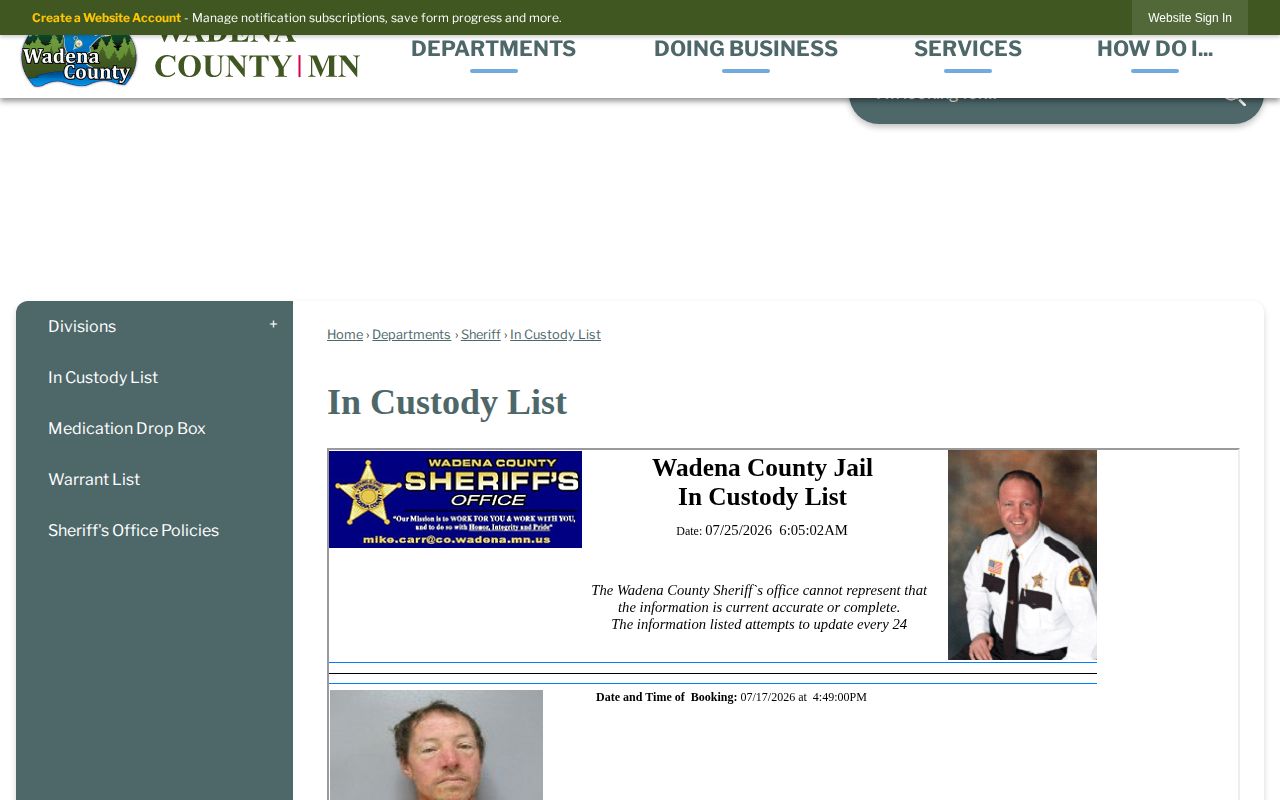 The screenshot helps identify the correct county source while preserving the key limit: it lists current custody, not everyone released during the prior 72 hours.
Anyone checking one person can use the Wadena County release search and records workflow. A feed-style review needs a bounded request for all release and transfer events within the chosen period.
Reconstruct Wadena County Three-Day Releases
Choose the exact start and end time before looking. “Last 72 hours” is a moving interval, while “Friday through Sunday” is a fixed date range. The request and court review should use the same boundaries so records are not omitted or counted twice.
- Record the date, time, and time zone at the start of the review. Define whether the interval rolls backward 72 hours or covers named calendar days.
- Check the Wadena current-custody page and preserve its generated timestamp. Use it only as a present-custody snapshot.
- Search known people in Minnesota VINE and preserve any release or transfer notice. VINE does not provide a public all-person three-day archive.
- Ask WCSO for release events within the exact interval, including date, time, and legal basis. Also request transfers with receiving agency details.
- Review Wadena cases in Minnesota Court Records Online for orders, dismissals, and sentence entries that fall near the interval.
- Follow transfers into the receiving system. Use MNDOC for state prison, BOP for federal prison, or the named jail when another county received the person.
The same-day Wadena County 24-Hour Releases workflow places more weight on immediate calls and notifications. A 72-hour review places more weight on complete agency records and clear date boundaries.
Wadena Three-Day Release Fields
No published 72-hour table exists, so the needed field set comes from Minnesota public release and transfer data. A well-defined WCSO request should separate actual community releases from moves to another custodian. It should also identify the booking episode, because one person can have more than one county custody event.
| Requested field | Purpose in a 72-hour review |
|---|---|
| Full name and identifier | Connects the event to the correct person and booking |
| Booking date and time | Defines the county custody episode that ended |
| Release date and time | Places an actual release within or outside the chosen interval |
| Legal basis for release | Distinguishes bond, court order, sentence completion, dismissal, or another basis |
| Transfer date and time | Marks the end of Wadena custody without assuming community release |
| Receiving agency or person | Identifies the next custodian or authorized recipient |
| Charge or court file number | Links the custody event to its legal context |
The current roster has booking details, charges, status, sentence start, and a projected release date. Those fields can help identify a case, but they do not replace the actual release and transfer fields above. A projected date is a plan that can change.
Wadena Weekend Release Review
No official source describes a standard Wadena County weekend or holiday release practice. It would be unsafe to claim that releases occur at a fixed time, use a certain door, or wait until the next business day. Court action, bond processing, sentence calculations, transfers, and jail administration can produce different timelines.
The value of a three-day review is practical, not procedural. It can span a weekend when records offices have limited hours and can include events that a person did not see on the current roster. Use exact timestamps from WCSO and VINE instead of assigning an event to a day based on when a webpage was checked.
Holiday closures matter for follow-up. Records Management is listed for Monday through Friday, excluding holidays. A request can still define the weekend interval precisely, but a response time should not be promised. Immediate custody concerns belong with the jail, while the written record can follow through the normal data process.
A Monday check also needs an explicit starting point. A rolling 72-hour period counted back from Monday afternoon differs from a request for all Friday, Saturday, and Sunday events. Use full timestamps where possible. If a report supplies only a date, ask the records office how its maintained field should be read rather than assigning an assumed midnight time.
VINE can help when registration occurred before the event. Searching after a weekend may return a present status, but the service is not a public export of every Wadena change in that span. Preserve any notice that was received and then request the underlying WCSO field for the actual release or transfer basis.
Note: Wadena County publishes no fixed weekend cadence, so the actual agency timestamp must control any three-day release timeline.
Request Wadena 72-Hour Records
Use the WCSO Data Requests page for the durable three-day record. A group request should name the start and end timestamps and ask for all public release and transfer events in that period. A named-person request should include enough details to isolate the booking. Ask for release date, time, and legal basis under section 13.82, subdivision 2(i), plus transfer date, time, basis, and receiving agency under subdivision 2(h).
The sheriff accepts records questions at wcso.records@wcmn.us. Records Management and Civil Process is listed at 218-632-6059 during weekday hours. Free inspection is available, and the county's form states its current copy and media terms. The office may need clarification and can withhold or redact data when law requires it.
If the Wadena event involved a city police department, that originating department may keep its own incident record. If the person transferred away, the WCSO record establishes the county exit while the receiving agency supplies the next custody or discharge record. This chain is more reliable than trying to infer three days of movement from one current roster snapshot.
Wadena Release Retention Gaps
Wadena County states no online retention period for released names because no released-person view was located. The In Custody List is built for current confinement. Its structure does not promise that a person remains visible for a few minutes, a full day, three days, or any other period after custody ends.
The sheriff's data-classification inventory confirms that back-end records go beyond the live page. It identifies release notifications, Huber or work-release records, prisoner-property envelopes, and monthly inmate statistical reports. Those sources show that release-related records exist, but the inventory does not publish a retention schedule or turn them into a public rolling feed.
A records request can ask for the applicable retention schedule if an older item cannot be located. For a three-day review, it can also request the source records instead of a newly created summary. Minnesota law does not require an agency to create data it does not maintain in the requested form.
The monthly inmate statistical reports identified by WCSO may be useful for aggregate study, but they do not answer a near-term named-person question and should not be used to manufacture a roster. A three-day request should stay focused on maintained release and transfer entries within the defined range. This reduces ambiguity and lets the office identify responsive public data without asking it to build a new report.
Property-return and Huber records also require context. A returned-property signature can add an administrative trail, while Huber release means temporary authorized work release and not final discharge. Neither record should replace the statutory release or transfer field. They are supporting records only when the specific custody episode calls for them.
Verify Each Wadena Custody Ending
Every apparent roster removal needs a destination check. A WCSO release record can establish that the person left for the community under a stated legal basis. A transfer record can instead name MNDOC, another jail, a federal custodian, or another receiving authority. Both events end county custody, but only one is a community release.
MNDOC PublicViewer may show “Incarcerated” after a transfer or “Under Supervision” after prison confinement ends. The latter can include a release type, date, and unit while state jurisdiction continues. BOP and ICE use separate federal systems. No state or federal result should be treated as proof of the earlier Wadena event unless the county transfer data connects them.
Court records supply the legal reason, such as bond, dismissal, sentence, or another order. They do not provide a real-time physical location. The sound three-day record pairs the sheriff's custody-end fields with the appropriate court or receiving-system record.